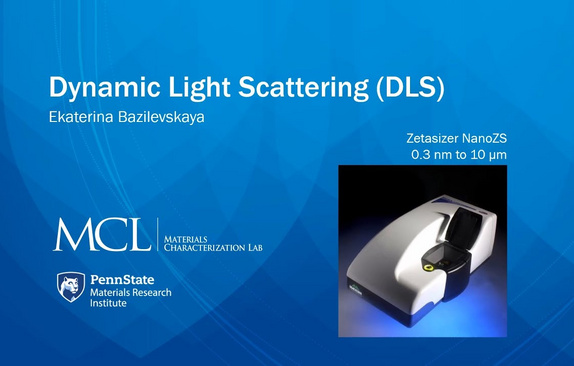
Dynamic Light Scattering (DLS)
LS Instruments LS Spectrometer™ II
The LS Spectrometer™ II is a versatile variable multi-angle light scattering instrument that enables the measurement of size distributions using dynamic and static light scattering over a wide size range (0.15 nm to 5 µm). Dynamic light scattering (DLS), also known as photon correlation spectroscopy (PCS) or quasi-elastic light scattering (QELS), is based on the analysis of the Brownian motion of particles in suspension. The diffusion coefficient is determined from the autocorrelation function of the scattered photons and converted into the hydrodynamic radius Rh using the Stokes-Einstein relation.
The LS Spectrometer™ II offers additional capabilities using depolarized dynamic light scattering (DDLS) to separately analyze rotational and translational diffusion. This enables the investigation of anisotropic particles.
Typical samples that can be analyzed include:
- Nanoparticles (e.g., gold, silver, or silica nanoparticles)
- Polymers
- Proteins (e.g., for analyzing aggregation behavior)
- Colloidal suspensions
- Emulsions
- Liposomes and vesicles
- …
Our instrument features two detectors that enable artifact-free measurement of particle sizes below 5 nm using pseudo-cross-correlation. The precise goniometer also allows for the measurement of static light scattering (SLS), which enables the determination of the radius of gyration and molar mass via a Zimm plot.
The pre-installed LSLab™ software offers automated data analysis, for example, through cumulant analysis or CORENN (a CONTIN alternative), for rapid determination of the hydrodynamic radius.
For more complex models and the analysis of anisotropic particles, manual data preparation and analysis are required.
If you require assistance with the evaluation, the device manager can handle this for you (see terms of use).
Possible applications
- Dynamic Light Scattering (DLS); Determination of:
- Hydrodynamic radius Rh
- Diffusion coefficient D
- Polydispersity index/size distribution
- Viscosity using tracer particles of known size.
- Depolarized DLS enables the measurement of:
- Rotational diffusion coefficient
- Shape/anisotropy.
- Multi-angle SLS measurements provide:
- Molar mass Mw
- Gyration radius Rg
- Structure factor S(q)
- 2nd virial coefficient.
- Furthermore, precise temperature and time series measurements are possible for characterizing stability/aggregation behavior.
Contact Person

Währinger Straße 38-42
1090
Wien
Room: 3327
Email
Copy email to clipboard
+43-1-4277-73813
Terms of use and usage fees
You must pass the following tests to be authorised to use this device independently after the initial training:
- General Safety Guidelines for Faculty Members
- Laboratory Safety
- Laser Safety
| User group | Hourly Rate | Cost per sample | Note |
|---|---|---|---|
| Faculties of Physics and Chemistry | - | - | 1. |
| Vienna Life Science Instruments | 7.5 € | 9 € | 2. |
| University users | 15 € | 9 € | 2. |
| Non-university users | 30 € | 9 € |
- For extensive measurement series, the users need to purchase cuvettes.
- Under a publication agreement, the hourly rate is waived and the cost per sample is negotiable.
We also charge for the costs of our staff for training sessions and measurements that cannot be carried out independently.
| User group | Hourly Rate for the Operator | Note |
|---|---|---|
| Faculties of Physics and Chemistry | - | |
| Vienna Life Science Instruments | 70 € | 1. |
| University users | 70 € | 1. |
| Non-university users | 100 € |
- Under a publication agreement, the hourly rate for our employees is also waived.
Specifications
| Device Parameter | Value or Range |
|---|---|
| Sample Volume | 50µl to 2 ml |
| Hydrodynamic Radius | 0.15nm to 5µm |
| Radius of Gyration | 5nm to 5µm |
| Molecular Weight | 360 to 3.600.000 Dalton |
| Goniometer | 15° to 150° |
| Goniometer Resolution | 0.05° |
| Laser | 638nm 120mW |
| Intensity | 0.001% to 100% in 8 Steps |
| Correlator | 12.5ns to 15h 320 Channels |
| Detector | 2 APDs QE 65% Dark Counts ca. 50cps |
| Temperature Range | >Dew Point up to 90°C |
| Indexmatching Fluid | Cargill 5030 (non-toxic) |
Downloads
Downloads are only visible to logged-in staff of the Chemistry and Physics departments. Click here to log in.